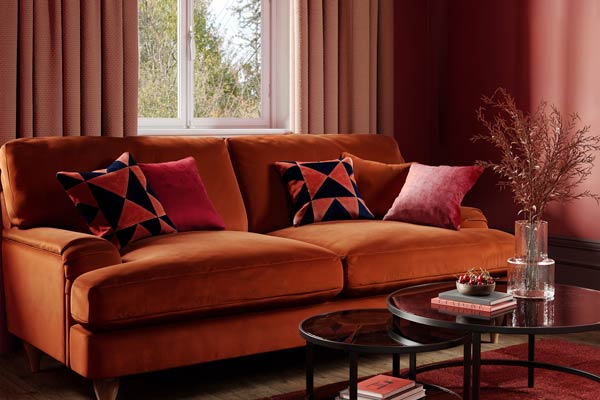
Consider colour capping for a visually intriguing yet tranquil effect. Making any space feel considered and cohesive, colour capping involves using varying tones of a single colour right up to the ceiling. It’s subtle, it’s sophisticated – and it’s surprisingly easy to achieve.
No more white ceilings and woodwork
This elevated look creates a sense of harmony without sharp breaks (goodbye, white skirtings and ceilings). The room feels bigger than it really is, because the eye travels seamlessly around it. Flat surfaces gain depth and the whole space feels enveloping, calm and intimate. The look works especially well in period homes, where features such as architraves, dado rails and cornicing can be washed in with the graduating colours, enhancing their detail and adding to the sense of character. In modern homes, meanwhile, colour capping provides depth and understated variations of colour where architectural features may be lacking.
Use a simple decorating guideline
The secret to colour capping is employing a variety of tones. You’ll need to pick at least three different shades from the same family. Proportion is vital and one of the most successful ways to achieve this is to follow the tried-and-tested 60:30:10 rule. Simply use one main hue over 60% of the room, a feature colour for 30% and an accent colour for 10%. For a brighter, airy look, apply 60:30:10 from top to bottom or, for a darker, more dramatic look, go from bottom to top.
Where to use colour capping
This look can work in almost any room but is most effective in a space where you want to create atmosphere and intimacy. When applying it to living rooms and bedrooms, especially if you use the darkest tone for the ceiling, colour capping creates a cocooning effect. In open-plan spaces, it can be used to zone areas for different uses.
However, take care if the room is very dark or has low ceilings – in this case, it may be better to stick to a one-colour scheme and use accessories for subtle interest instead.
Choosing colours and finishes
This is the fun part. Paint company colour charts and websites make it straightforward to choose coordinating shades of the same colour. Just bear in mind that you should keep the contrasts strong enough to tell the difference between the shades but not so strong they don’t harmonise.
Pale neutrals are perfect when you want a light, bright, airy feel for smaller or north-facing rooms, where it’s best to avoid stark whites. For warmth and drama, vibrant reds, oranges and mustards fit the bill, while earthy, organic tones of olive, brown and ochre feel truly relaxing and comforting. Deep colours such as navy, charcoal and forest green can be smart and striking, while pastels like sage, cornflower, lilac and dusky pink are elegant in a well-balanced interior.
Vary finishes, too. Gloss reflects light, while the matt finish of emulsion hides imperfections, with satin and eggshell offering yet another chance to create a pulled-together look. Remember that colours can look very different in different lights, so test first with colour swatches.
Finishing touches
As with paint finishes, textural contrast is important in building atmosphere. Use a combination of interesting finishes such as velvet upholstery, linen curtains, wicker baskets and ceramic vases, with metallic accents – such as brass handles or a chrome lamp base.
Finally, choose furniture, window treatments and wall art to echo the tones of your scheme or provide a subtle contrast – such as a russet sofa for a colour pop in a deep-pink living room.